🪻Women who met God in prayer, tears, and trust, intercession, intimacy with God, and spiritual power.
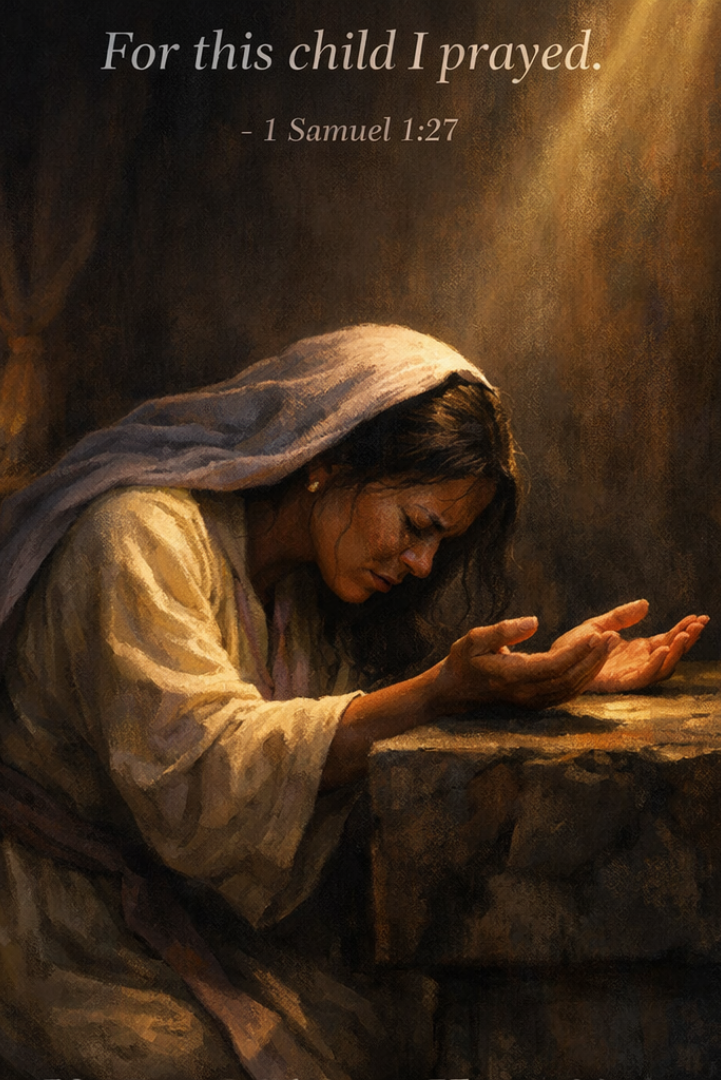
Scripture: 1 Samuel 1:27 (KJV) “For this child I prayed; and the Lord hath given me my petition which I asked of him.”
Hannah: Tears at the Altar… For This Child, I Pray
Devotional Thought
Hannah didn’t just want a child — she wanted God’s will.
Before Samuel was ever born, he was covered in prayer. And before she ever held him, she surrendered him.
That is what it means to be set apart.
As mothers, mentors, and spiritual mothers, we are not called to control the children entrusted to us. We are called to cover them. In prayer. In truth. In faith.
These are not ordinary times.
And we are not raising ordinary children.
So on this Set Apart Sunday, we recommit them to the Lord of Hosts — the God who fights for what we cannot see.
“For this child I prayed” is not just a testimony.
It is a lifestyle.
Daily Journal Prompt
What fears do I carry about my child’s future — and have I truly surrendered them to God?
Write a specific prayer over:
- Their identity
- Their friendships
- Their faith
- Their purpose
- Their protection
Then speak it aloud.
Set Apart Mother
Lord,
I come before You not as a perfect mother,
but as a praying one.
You entrusted this child to me,
but they belong to You first.
Where I feel anxious, give me peace.
Where I feel unsure, give me wisdom.
Where I feel overwhelmed, remind me that You are the Lord of Hosts.
Teach me to respond in prayer before I react in fear.
Guard my child’s mind, heart, identity, and purpose.
Shield them from confusion, from compromise, from the subtle lies of culture.
Let my home be covered in truth.
Let my words plant faith.
Let my prayers build protection around their future.
I release control.
I choose surrender.
I stand watch in the Spirit.
For this child, I will keep praying.
For this child, I will trust You completely.
In Jesus’ name,
Amen.
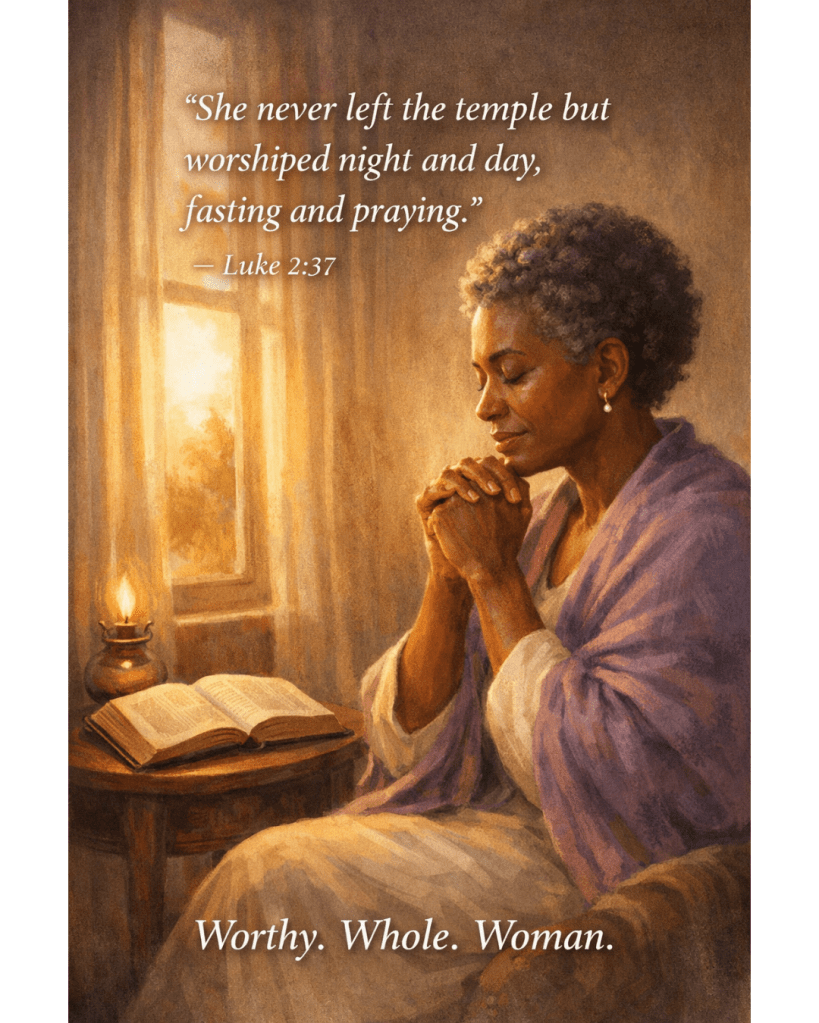
Anna the Prophetess — The Devoted Seeker
Scripture:
“She never left the temple but worshiped night and day, fasting and praying.”
Luke 2:37 (NIV)
Devotional Thought
Many women believe their most powerful years are behind them. But Anna proves otherwise.
Anna was older when Mary and Joseph brought Jesus to the temple, yet she immediately recognized the Messiah. Why? Because she had cultivated a life of prayer and fasting. Her devotion sharpened her discernment.
The Bible says she “never left the temple but worshiped night and day.” Her strength did not come from a platform. It came from presence. She saw what others missed because she had spent time with God.
We don’t have to wait until we are older to live like Anna. Wisdom and spiritual depth belong to any woman who commits herself to prayer.
When women pray consistently, they don’t miss God when He moves.
Today, let’s turn down the noise and turn toward Him.
Worthy. Whole. Woman.
Daily Journal Prompt
Anna recognized Jesus because she had trained her heart to recognize God.
Today, reflect and write:
- What “noise” in my life is competing with my time in prayer?
- If someone observed my daily routine, would they see devotion as a priority?
- What would it look like for me to worship “night and day” in this season of my life?
- Where might I be missing God because I have not slowed down enough to discern Him?
- How can I intentionally incorporate fasting or focused prayer into my week?
Write honestly. Invite God into your reflection.
Prayer
Father God,
Thank You for the example of Anna, a woman who chose devotion over distraction. Thank You that wisdom is not reserved for age, but for those who diligently seek You.
Lord, quiet the noise around me. Help me to turn down the volume of the world so I can hear Your voice clearly. Teach me to value Your presence more than popularity, and intimacy with You more than attention from others.
Create in me a heart that longs to worship daily. Give me discipline in prayer, boldness in fasting, and consistency in seeking You. Sharpen my discernment so that I never miss You when You move.
Let me recognize Your presence in ordinary moments. Let me be spiritually awake. Let my life reflect devotion that is steady, humble, and sincere.
I do not want to wait until later in life to be wise. I choose today to pursue You fully.
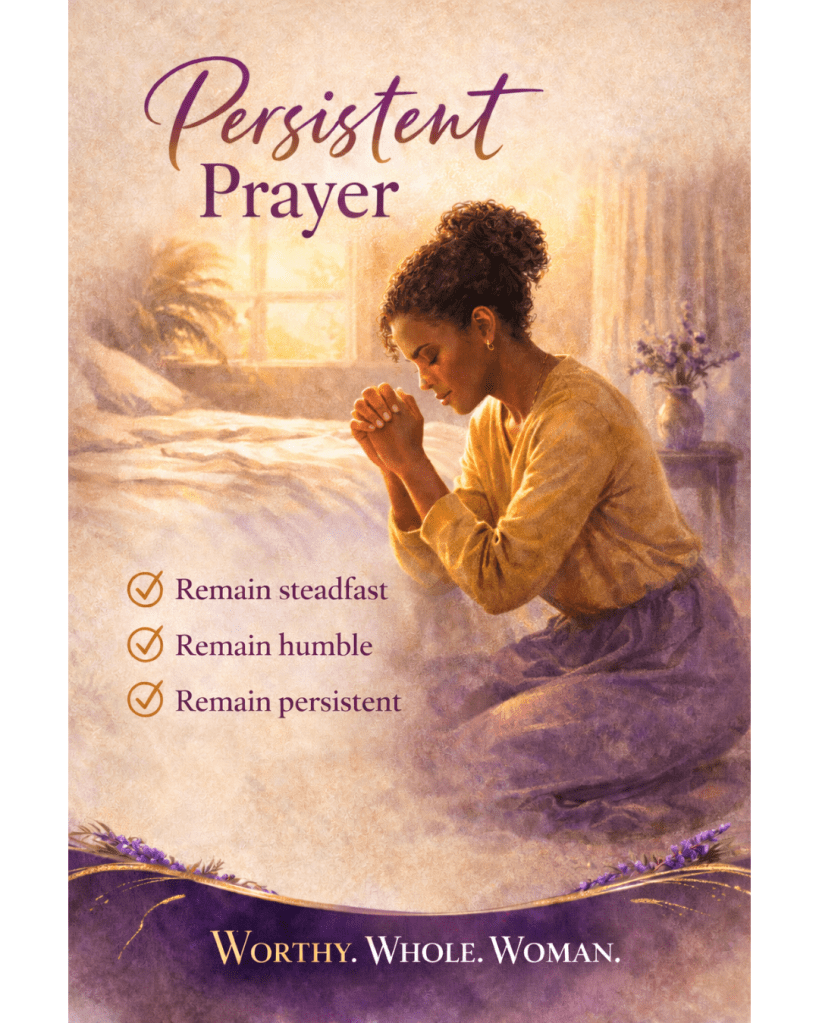
The Woman of Persistent Prayer-The Power of a Woman Who Won’t Quit
Scripture
The parable of the persistent widow reminds us that we “ought always to pray and not lose heart.”
— Luke 18:1–5
For some women, prayer comes easily. They wake up already in a posture of communion with God. But for others, prayer feels hard—not because they don’t want to pray, but because they’ve never been taught how, they feel like their prayers haven’t been answered, or they worry they’re doing it wrong.
Prayer does not have to be boisterous to be heard by God. It does not have to happen at a certain time of day or last for hours. Prayer simply needs to be raw and honest. We don’t always have to be on bended knee with closed eyes in a prayer closet—but we must always have the right heart posture. We pray not for our will to be done, but for His.
If we desire constant communion with God, we should pray about everything. Be dogmatic about it. Just as the persistent widow would not stop going to the judge until she received justice, we must not stop praying. Not because God is reluctant—but because we refuse to lose heart. Not because we need to pressure Him—but because we want to remain close to Him.
Prayer should never be our last resort. It should be our constant conversation with the Father.
Unlike the unjust judge, God is not reluctant. He delights in hearing us. He rejoices in answering us. How much more does He desire to help His daughters when we stay in constant communication with Him—asking Him to intercede, to guide, to keep us?
Persistent prayer means praying without ceasing.
It means praying when you wake up.
Praying as you move through your day.
Offering thanksgiving just as often as petitions.
Praying for others as faithfully as you pray for yourself.
Sis, imagine how powerful your life would be if you applied that same persistence you use to accomplish your goals to your prayer life.
Don’t put prayer on the slow burner.
Move it to the front. Let the flame burn higher.
The widow had to overcome a reluctant judge.
We don’t.
God is not hesitant. He is attentive.
And persistent prayer doesn’t change God—it changes you. It transforms you. It keeps you abiding in the Vine and anchored in His Word.
Prayer is a lifestyle choice.
Choose wisely.
Will you pray only when the storm is moving in?
Or will you pray always—whether in sunshine or rain?
Daily Journal Prompt:
Where in my life have I grown weary in prayer — and what would it look like to shift from praying for results to praying for relationship?
Write about one area where you will commit to persistent, daily prayer this week and how you will intentionally keep it on the “front burner.”
Prayer:
Father God,
Teach me to pray with persistence and not pressure. Help me to come to You daily — not just when I need something, but because I need You. Correct my heart posture when I make prayer about my will instead of Yours.
Give me the courage to keep praying when I do not see immediate results. Strengthen my faith when answers feel delayed. Remind me that You are not a reluctant judge, but a loving Father who delights in hearing from His daughter.
Transform me through consistent communion with You. Let prayer become my first response, not my last resort. Keep me close to the Vine so I do not lose heart.
I choose a lifestyle of prayer — in sunshine and in storm.
In Jesus’ name,
Amen
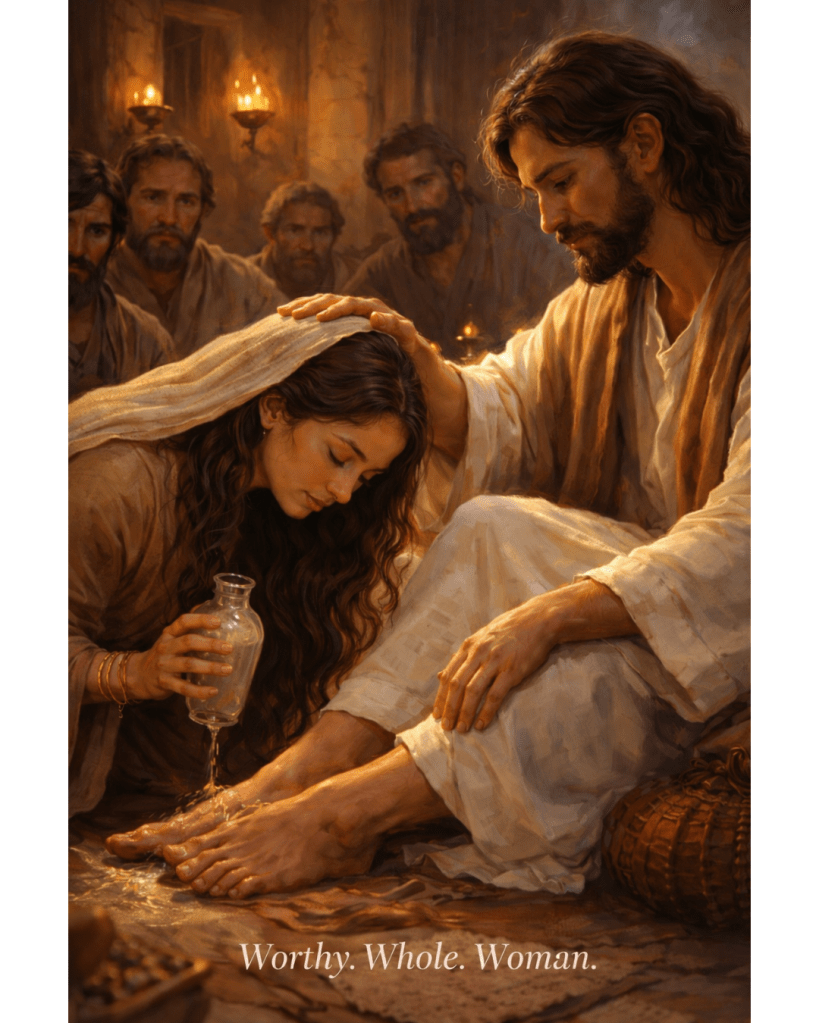
Mary of Bethany: The Cost, The Courage, The Call
Scripture
“Mary has chosen what is better, and it will not be taken away from her.”
Luke 10:42 (NIV)
Devotional Thought
Six days before Passover, Mary took a jar of expensive perfume—worth a year’s wages—and poured it on Jesus’ feet (John 12:1–3). While others questioned her, she worshiped. While Judas criticized, she poured. While Martha served, she surrendered.
Mary understood something we often forget:
Revival costs.
Jesus had raised her brother from the dead (John 11:43–44). Her worship was not performance—it was gratitude. It was love. It was sacrifice.
When women pray, we are not performing for people—we are pouring out before Jesus.
In today’s world, we are pressured to produce, post, and perform. But Mary reminds us that power comes from presence. Before she ever poured perfume, she had learned to sit at His feet (Luke 10:39). She chose the one thing that mattered (Luke 10:42).
When life feels chaotic, when something in your life feels dead—your peace, your joy, your direction—fall at His feet.
Because when women pray, heaven moves.
When women worship, atmospheres shift.
When women surrender, God revives what was dying.
We need more Marys—women willing to pour out, even if it costs.
Daily Journal Prompt
What in my life needs revival right now—and what might God be asking me to surrender in order to experience it?
Prayer
Lord Jesus,
Give me a Mary heart. Teach me to value Your presence over performance and intimacy over image. Show me what I need to surrender so You can breathe life into the places that feel weary or dry. Help me not to fear the cost of obedience. Let my prayers be bold, my worship sincere, and my devotion unwavering. Revive what is dying in me, and let my life carry the fragrance of Your presence.
In Jesus’ name, Amen. 💜
She Refused to Let Go – Great Faith Still Moves Heaven

Scripture
“Then Jesus answered and said to her, ‘O woman, great is your faith! Let it be to you as you desire.’ And her daughter was healed from that very hour.” Matthew 15:28
Devotional Thought
You need something from God, but you feel like He is not hearing you. The noise of the crowd is too loud, and you are not exactly the most holiest of people. But prayer is for all those who need it, want it, and use it.
The Syrophoenician woman refused to leave Jesus until He was willing to heal her daughter. Even when He did not answer immediately. Even when the disciples tried to send her away. Even when it would have been easier to walk away embarrassed.
She was ten toes down.
In a world where everything is instant—instant communication, instant likes, instant deliveries—persistence feels foreign. The first hard thing that comes our way, we give up on because it causes discomfort. But true persistence must outlast opposition, fear, and what other people think.
For many Christians, if the answer is not immediate, we assume God is ignoring us. We turn away when that is the very moment we should be drawing near.
But this mother kept crying out.
She was a Gentile, not a Jew. She did not “qualify” by tradition. Yet she still threw herself before Jesus and pleaded for His help. And her persistence paid off.
Jesus called her faith great.
Persistence in prayer looks like being bold no matter the opposition. It looks like setting aside ego, surrendering everything to God, and refusing to allow the crowd to silence you. It looks like praying God’s Word back to Him because He is not a man that He should lie.
If she could remain steadfast knowing less than what we know about Jesus, how much more should we remain persistent knowing all that He has already done for us?
So today’s testimony is simple:
Stay ten toes down in prayer.
Do not let delay turn into doubt.
Do not let the crowd talk you out of your miracle.
Do not let silence make you shrink.
Remain faithful.
Remain humble.
Remain persistent.
And watch God move.
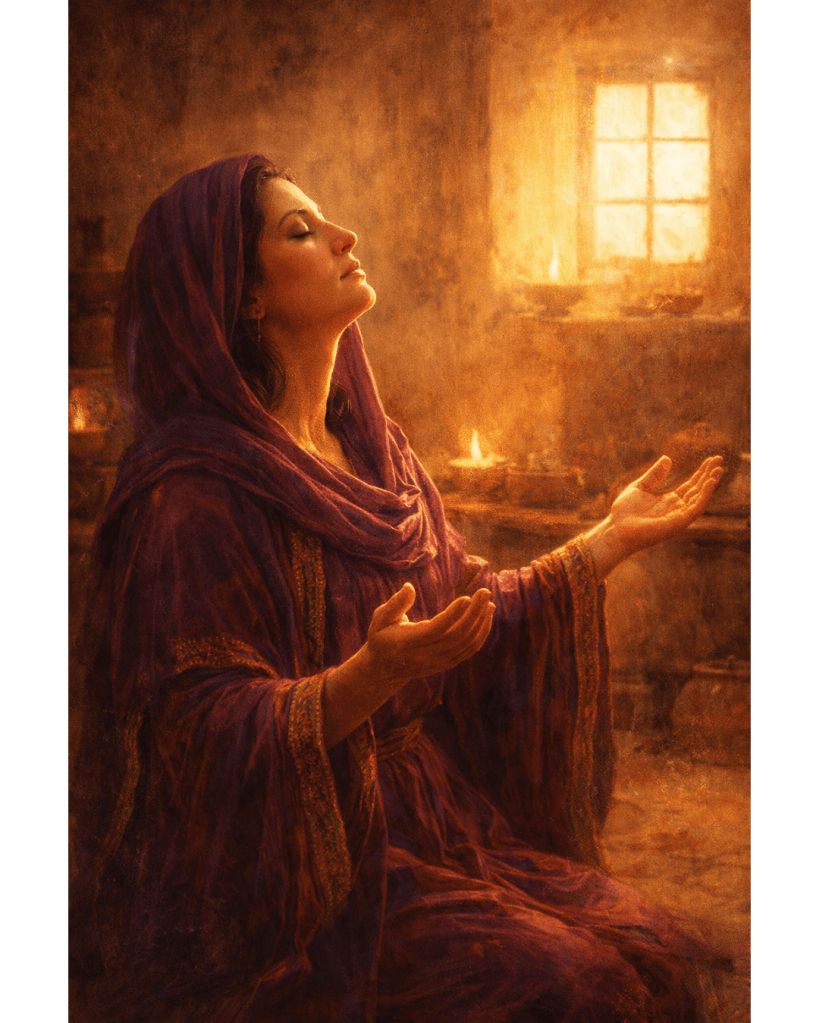
Lydia: Worship Is More Than a Song
Scripture
“One of those listening was a woman from the city of Thyatira named Lydia, a dealer in purple cloth. She was a worshiper of God… The Lord opened her heart to respond to Paul’s message. When she and the members of her household were baptized, she invited us to her home.” Acts of the Apostles 16:14–15 (NIV)
Devotional Thought
We don’t know much about Lydia except that she was a dealer of purple cloth—and, most importantly, a worshipper.
When we think of worship, we often think of singing. But singing is only one expression of worship. Worship can include singing, yes—but also dancing, prayer, generosity, obedience, and service.
The Bible does not tell us exactly what kind of worshipper Lydia was, but we do know that one form of her worship was service. She opened her home to Paul and his companions (Acts 16:14–15). Later, she opened her home for the gathering of believers—the early church itself (Acts 16:40). Her house became holy ground.
Like Lydia, we should always remain in the posture of worship—not because we want God to do something for us, but because God is simply God.
Worship must become more than singing songs on Sunday. It is bowing down in surrender. It is creating space for His presence. It is using what we have—our homes, our resources, our influence—for His glory.
Lydia spent so much time in worship that others looked to her as a spiritual leader. She gathered with other women to pray. Though she ran a household and a business, she still found time to worship God and fellowship with other believers.
Lydia reminds us that worship is not confined to a sanctuary. It can happen in a living room. Around a table. In the middle of a marketplace.
And sometimes, the most powerful act of worship is simply opening your door and saying, “Lord, use what You’ve given me.” 💜
Daily Journal Prompt
Lydia was known first as a worshiper (Acts 16:14).
Her worship was not performance — it was posture.
It was service. It was surrender. It was hospitality.
- What does worship look like in my life beyond singing?
- Am I using my home, gifts, resources, and influence as an offering to God?
- Where is God asking me to “open my heart” or “open my home” in this season?
- If someone described me in one word, would “worshiper” be one of them? Why or why not?
- What practical act of worship can I offer God this week?
Take a moment to write honestly. Let this be reflection, not performance.
Prayer
Father God,
Thank You for the example of Lydia — a woman who worshiped You not just with her lips, but with her life.
Teach me to worship beyond the songs I sing.
Let my obedience be worship.
Let my generosity be worship.
Let my service be worship.
Open my heart the way You opened Lydia’s heart.
Remove distraction, pride, and selfish ambition.
Help me to create space for Your presence in my home, my work, and my daily routines.
I do not worship You for what You can give me.
I worship You because You are holy.
You are worthy.
You are God.
Scripture: Do not be anxious about anything, but in every situation, by prayer and petition, with thanksgiving, present your requests to God. 7 And the peace of God, which transcends all understanding, will guard your hearts and your minds in Christ Jesus. Philippians 4: 6-7
May my life become a sanctuary.
In Jesus’ name, Amen. 💜
Praying Women Today
Devotional Thought
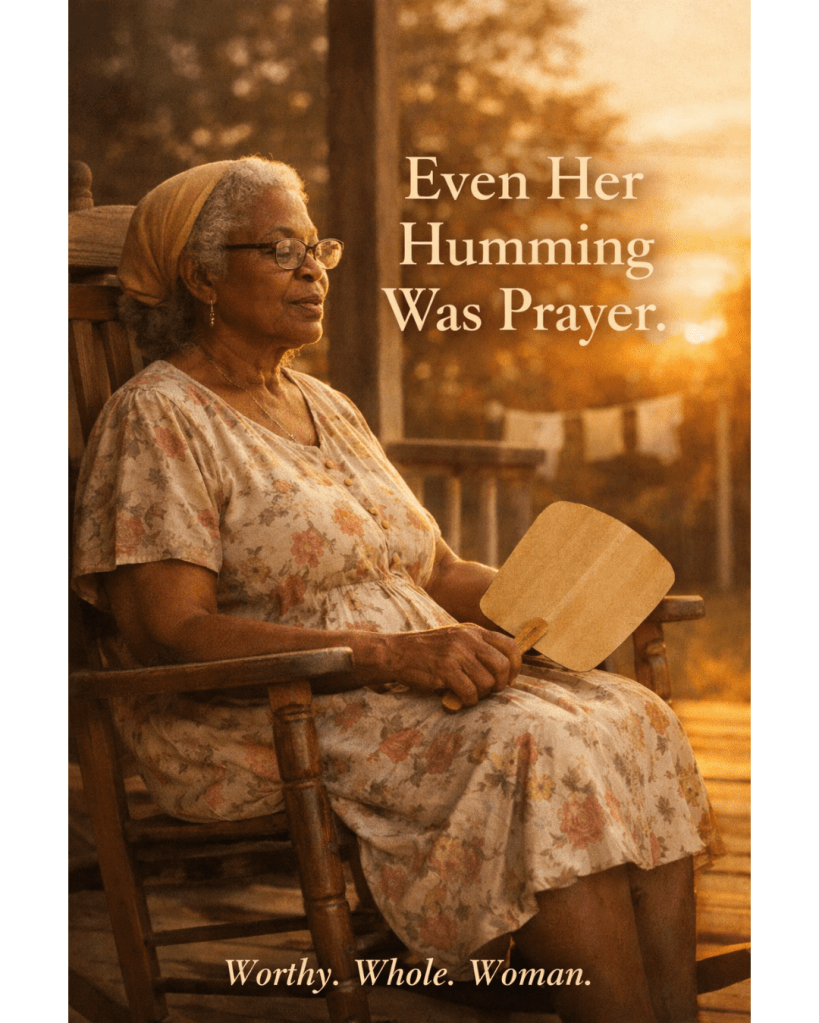
We have been told that we need pretty prayer closets or special prayer rooms to pray. But our Black grandmothers did not wait for a specific time or place.
“Give ear to my words, O Lord; consider my groaning.” — Psalm 5:1
David did not only ask God to hear his words — he asked Him to consider his groaning. Groaning has no polished sentences. It is not structured. It is a sound. A hum. A sigh pressed deep from the soul.
That humming my grandmother did while cleaning the house? Prayer.
That singing my mother did on her way to work? Prayer.
That church fan tapping against her knee while sitting in a rocking chair on the porch? Prayer.
That low spiritual barely above a whisper while hanging clothes on the line or picking peas? Prayer.
The old Negro spirituals were more than songs — they were sacred resistance. They were theology carried in melody. In the cotton fields of slavery, our ancestors could not always gather openly to pray, but they could sing. And so they prayed through song. “Give Me Jesus.” “Take My Hand, Precious Lord.” “Swing Low, Sweet Chariot.” These were not performances; they were petitions. They were coded hope. They were survival set to rhythm.
Those songs moved from the fields to the wooden floors of small country churches. They traveled from slavery into the Civil Rights Movement. They carried lament, longing, and unshakable belief that God was still listening. When words were dangerous, melody became prayer. When tears would not stop falling, harmony held them up.
Our grandmothers inherited that sound.
Sometimes there were no long, flowery prayers. Sometimes there was just a hymn under the breath. A verse repeated while stirring a pot. A melody carried from room to room. And though there were not always formal sentences spoken, Heaven understood every note.
Prayer was constant and a mainstay in the household.
Prayer was done upon waking and before going to sleep.
Prayer was done before each meal.
Prayer was done while rocking a baby to sleep to the humming of an old spiritual.
Those sounds had no speeches attached. No hour marked on a clock. But they were fervent. They were intense. They were heartfelt petitions rooted in deep faith.
And Heaven moved.
Heaven moved in their homes.
Heaven moved in their children.
Heaven moved in generations that came after them.
If we want Heaven to move like it did for our mothers and grandmothers, prayer must return to our homes — not as a scheduled event, but as a steady presence. It must return to our kitchens, our cars, our laundry rooms, and our porches. It must return to the hum beneath our breath and the song on our lips.
Not curated.
Not timed.
Not dependent on perfect words.
Just faithful.
Just constant.
Just like Grandma.
Daily Journal Prompt
Think about the women who shaped your faith — your mother, grandmother, aunt, or another praying woman in your life.
- What did their prayer life look like?
- What sounds remind you of their faith (humming, singing, whispered prayers, scripture recited)?
- When do you find yourself naturally communicating with God throughout your day?
- What would it look like for prayer to become constant in your home again — not scheduled, but woven in?
Write about one small way you can bring prayer back into your everyday rhythm — in your kitchen, your car, your quiet moments.
Prayer
Father God,
Teach me to pray like the women who came before me.
Not for performance. Not for show. Not to impress.
But to endure. To survive. To trust.
Help me to understand that You hear more than words. You hear my sighs. You hear my humming. You hear the quiet cry beneath my breath. Consider my groaning, Lord.
Let prayer return to my home — in my waking and my resting, in my cooking and my cleaning, in my driving and my waiting. Let it become constant again.
Give me the fervency of my grandmothers — the kind that did not need a clock, only faith. The kind that filled a house with Your presence.
May my children and grandchildren one day remember the sound of my prayers.
When I hum, hear me.
When I sigh, understand me.
When I cannot find the words, receive my heart.

 Worthy. Whole. Woman.